Maximum heart rate is commonly estimated as 220 − age: 180 at 40. A 2001 analysis of 351 studies (Tanaka et al.) found 208 − 0.7 × age fits adults better — about the same at 40 (180), but higher for older adults: 166 vs 160 at 60. All three formulas are averages; a real person’s maximum can be 10 or more beats away.
Estimated maximum at 40
220 − age
180bpm
Tanaka
180bpm
Gellish
179bpm
Tanaka = 208 − 0.7 × age (2001, pooled 351 studies) · Gellish = 207 − 0.7 × age (2007, repeated tests of the same people).
Max heart rate chart by age.
Estimated maximum heart rate (BPM) by formula
| Age | 220 − age | 208 − 0.7 × age | 207 − 0.7 × age | Gap (Tanaka − 220) |
|---|---|---|---|---|
| 20 | 200 | 194 | 193 | -6 |
| 25 | 195 | 191 | 190 | -4 |
| 30 | 190 | 187 | 186 | -3 |
| 35 | 185 | 184 | 183 | -1 |
| 40 | 180 | 180 | 179 | 0 |
| 45 | 175 | 177 | 176 | +2 |
| 50 | 170 | 173 | 172 | +3 |
| 55 | 165 | 170 | 169 | +5 |
| 60 | 160 | 166 | 165 | +6 |
| 65 | 155 | 163 | 162 | +8 |
| 70 | 150 | 159 | 158 | +9 |
| 75 | 145 | 156 | 155 | +11 |
| 80 | 140 | 152 | 151 | +12 |
Why there are three formulas
220 − age is easy to remember and is what the American Heart Association’s target-heart-rate chart uses. It was never fitted to a large data set.
208 − 0.7 × age comes from Tanaka, Monahan and Seals (2001), who pooled 351 studies of healthy adults and checked it in their own lab. It drops more slowly with age, so it gives older adults a higher maximum.
207 − 0.7 × age (Gellish, 2007) followed the same people over years of treadmill tests and landed almost on top of Tanaka.
What the number is for
Maximum heart rate is a yardstick for exercise intensity — your zones are percentages of it. It says nothing about fitness on its own: a higher maximum isn’t “better”.
It is also not a safety limit to aim for. If you take medicine that slows your pulse, formulas won’t fit you at all — go by effort and your clinician’s advice.

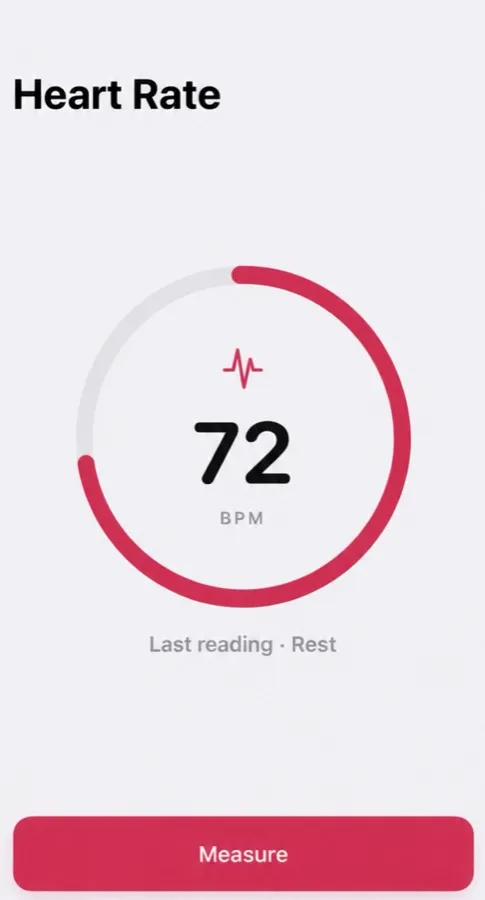
See how close you get. Pulse reads your heart rate right after a set.
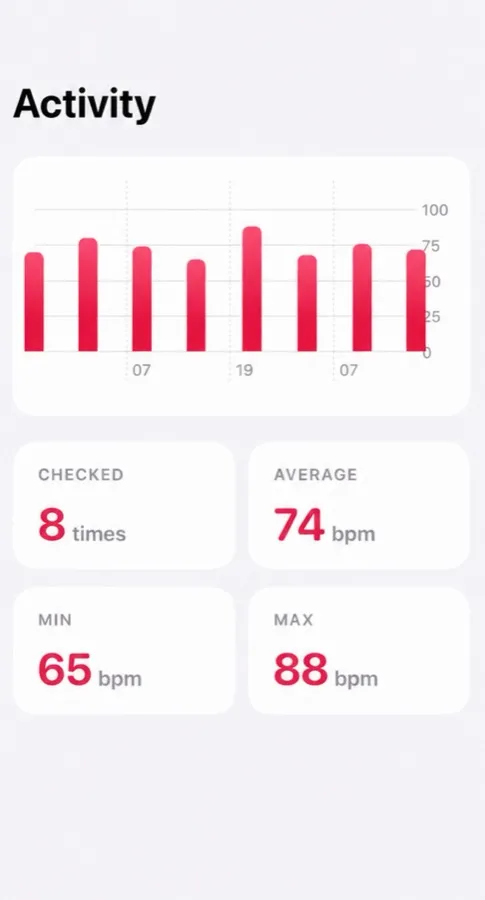
Cover the back camera with your fingertip — Pulse reads your heart rate from the light and keeps every reading, with your average, lowest and highest.
- Reads your pulse in about 15 seconds
- Tag each reading: morning, rest, workout, before bed
- History with average, min and max
Free to download, optional Pro. Not a medical device: Pulse reads and keeps your pulse, and it does not detect or predict disease. What the app does
Questions people ask
What is my max heart rate?
The quick estimate is 220 minus your age — 190 at 30, 170 at 50. The Tanaka formula (208 − 0.7 × age) gives 187 at 30 and 173 at 50. Your true maximum can only be found with a hard, supervised test.
Is 220 minus age accurate?
It is a rough average. Tanaka and colleagues pooled 351 studies in 2001 and found 220 − age underestimates the maximum of older adults; 208 − 0.7 × age fit better. Individuals still vary by 10 beats or more either way.
Does max heart rate go down with age?
Yes — by roughly 0.7 to 1 beat per year in these formulas. That is why a 60-year-old’s zones are lower than a 30-year-old’s, even at the same fitness.
Is it bad to reach my max heart rate?
Healthy, trained people reach it in hard intervals or races. If you are new to exercise or have a heart condition, build up gradually and ask your clinician what intensity is right for you.
General information, not medical advice — medical disclaimer. Reviewed : sources and reference dates are listed below.
Sources · numbers checked · how we calculate · report an error
- Tanaka H, Monahan KD, Seals DR. Age-predicted maximal heart rate revisited. J Am Coll Cardiol. 2001;37(1):153–156.
- Gellish RL, et al. Longitudinal modeling of the relationship between age and maximal heart rate. Med Sci Sports Exerc. 2007;39(5):822–829.
- American Heart Association. Target Heart Rates Chart.