Your resting pulse is lowest and steadiest right after you wake, before you get up — when the American Heart Association suggests checking it. One morning can be off by several beats, so check 7 mornings in a row and use the middle value. Add the reminders to your calendar, then type your 7 numbers below.
1 · Reminders
Add 7 mornings to my calendar7 calendar events, 5 minutes each, with an alert — works with Apple, Google and Outlook calendars. Nothing is sent to us.
2 · Your 7 mornings (BPM)
Your resting pulse
—bpm · middle value
Type at least 3 mornings (0 so far).
How to do each morning
- When the alarm goes, stay lying down. Don’t check your phone yet.
- Find your pulse at the wrist or neck with two fingers (how), or read it with the Pulse app.
- Count for 30 seconds and double it. Write the number down.
- Same position, same time, every morning. After 7 mornings, type them above.
Why the middle value
The middle value (median) of 7 mornings ignores one odd day — a late night, alcohol, a bad dream, a cold coming on. An average would let that one morning pull the number.
Readings that wander by 5–10 beats from morning to morning are common. A number that keeps climbing over several mornings, without an obvious reason, is worth noting and showing to your clinician if it continues.
Why track your resting heart rate at all
The benefit of a morning check is the record, not one number. In a study of 92,457 people wearing trackers:
- Your normal is personal. One person’s normal resting pulse could differ from another’s by nearly 70 BPM.
- Your own number is steady. The average person moved about 3 BPM from day to day.
- Real swings happen. About 1 in 5 people had at least one week that moved by 10 BPM or more.
- Seasons count a little. The average shifted about 2 BPM over the year, highest in January, lowest in July.
What a record gives you
- A real baseline instead of a guess, so you know what “high for me” means.
- Context: you can see the effect of a bad night, a drink or a cold. See what raises your heart rate.
- Fitness feedback if you are training. See how to lower your resting heart rate.
- Something to show your doctor. Dates and numbers are more useful than “my watch said 110 once”.
A record shows your numbers. It can’t tell you whether your heart is healthy, so please don’t use it that way. Population studies do link resting pulse with long-term health: see resting heart rate and longevity.

Let the app keep all 7. Pulse logs every morning for you.
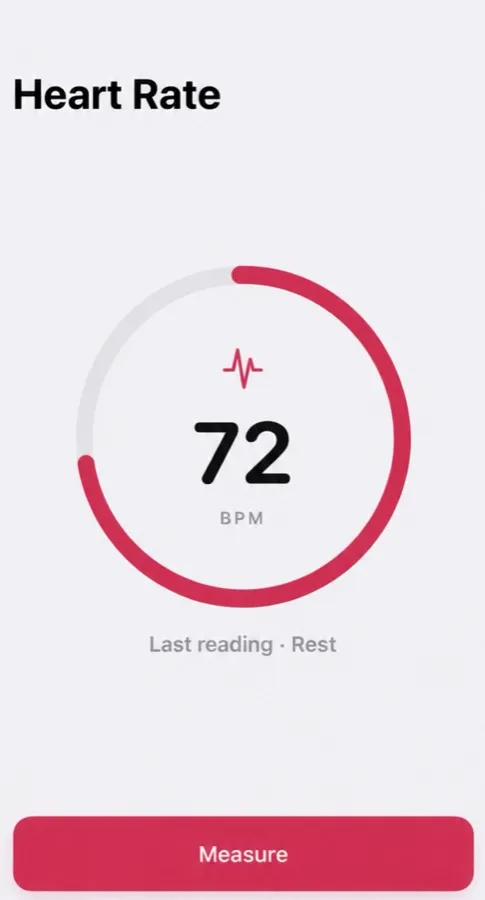
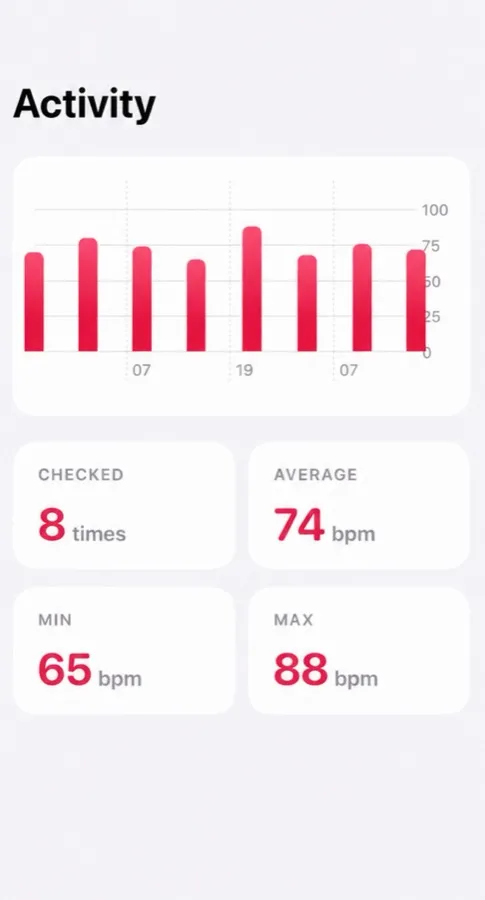
Read your pulse with the iPhone camera before you get up and tag it “Morning” — Pulse keeps the history with your average, lowest and highest, so there is nothing to write down.
- Reads your pulse in about 15 seconds
- Tag each reading: morning, rest, workout, before bed
- History with average, min and max
Free to download, optional Pro. Not a medical device: Pulse reads and keeps your pulse, and it does not detect or predict disease. What the app does
Questions people ask
When is the best time to check resting heart rate?
In the morning, right after you wake and before you get out of bed — the American Heart Association’s advice. You haven’t moved, eaten or had coffee yet, so the number is as close to resting as it gets.
Why 7 mornings and not one?
A single reading is noisy. In the CDC study, the same people measured on two different days by trained examiners matched only moderately (a correlation of 0.69). The middle value of 7 mornings smooths out a bad night or an early alarm.
Is heart rate higher in the morning?
Right after waking it is usually at its lowest of the day, then it rises as you get up and move. More on morning heart rate.
What should I do with my 7-morning number?
Compare it with people your age on the home page, use it as the resting pulse in the zones calculator, and repeat the check every few months to see your trend.
General information, not medical advice — medical disclaimer. Reviewed : sources and reference dates are listed below.
Sources · numbers checked · how we calculate · report an error
- American Heart Association. Target Heart Rates Chart.
- Ostchega Y, Porter KS, Hughes J, Dillon CF, Nwankwo T. Resting pulse rate reference data for children, adolescents, and adults: United States, 1999–2008. National Health Statistics Reports No. 41. NCHS, 2011.
- Quer G, Gouda P, Galarnyk M, Topol EJ, Steinhubl SR. Inter- and intraindividual variability in daily resting heart rate and its associations with age, sex, sleep, BMI, and time of year. PLoS One. 2020;15(2):e0227709.
Morning pulse log — 7 mornings
Reviewed
Count before you get out of bed: 30 seconds × 2. checkmybpm.pages.dev/morning-check/
| Day | Date | Time | BPM | Notes (sleep, alcohol, illness) |
|---|---|---|---|---|
| 1 | ||||
| 2 | ||||
| 3 | ||||
| 4 | ||||
| 5 | ||||
| 6 | ||||
| 7 |
Middle value (sort the 7 numbers, take the 4th): ______ BPM