Is your heart rate normal? See what your number means.
Reviewed
A resting heart rate of 60–100 BPM is the American Heart Association’s adult range. In CDC measurements of 14,200 adults, the middle value was about 70 BPM. Enter a pulse you already have and your age below to compare it with the CDC reference. This website does not measure pulse.
CDC data · 14,200 adults · No sign-up · Nothing you type leaves your device
Your resting pulse
72 BPM at rest is inside the 60–100 range the AHA uses for adults — higher than about 56 in 100 people aged 40–59 (CDC).
Resting pulse · ages 40–59 · CDC
Percentile
56of 100
Middle value
70bpm
90 in 100 between
54–91bpm
CDC sample
4,968people
Is my BPM normal? Every number from 40 to 200.
Find your number. “Higher than” = how many in 100 adults of that age have a lower resting pulse (CDC). Above about 105 at rest, you are past the 99th percentile in every adult age group — but the same number is ordinary while you move.
Resting heart rate 40–200 BPM: AHA range, CDC percentile by age, and when you usually see it
| BPM | AHA 60–100 (at rest) | Higher than · 20–39 | Higher than · 40–59 | Higher than · 60–79 | Usually seen when |
|---|---|---|---|---|---|
| 40 BPM | Below | <1 | <1 | <1 | Asleep, or at rest in very fit people |
| 45 BPM | Below | <1 | <1 | <1 | Asleep, or at rest in very fit people |
| 50 BPM | Below | 2 | 2 | 2 | Asleep, waking, or at rest if you are fit |
| 55 BPM | Below | 6 | 6 | 7 | Asleep, waking, or at rest if you are fit |
| 60 BPM | Inside | 16 | 19 | 20 | Sitting quietly |
| 65 BPM | Inside | 28 | 34 | 35 | Sitting quietly |
| 70 BPM | Inside | 46 | 50 | 53 | Sitting quietly |
| 75 BPM | Inside | 62 | 65 | 68 | Sitting quietly |
| 80 BPM | Inside | 76 | 78 | 80 | Sitting quietly |
| 85 BPM | Inside | 86 | 88 | 90 | Sitting, standing, after coffee or a meal |
| 90 BPM | Inside | 93 | 94 | 94 | Sitting, standing, after coffee or a meal |
| 95 BPM | Inside | 96 | 97 | 96 | Sitting, standing, after coffee or a meal |
| 100 BPM | Top edge | 98 | 98 | 98 | Sitting, standing, after coffee or a meal |
| 105 BPM | Above | >99 | >99 | >99 | Walking, climbing stairs, standing up fast |
| 110 BPM | Above | >99 | >99 | >99 | Walking, climbing stairs, standing up fast |
| 115 BPM | Above | >99 | >99 | >99 | Walking, climbing stairs, standing up fast |
| 120 BPM | Above | >99 | >99 | >99 | Walking, climbing stairs, standing up fast |
| 125 BPM | Above | >99 | >99 | >99 | Walking, climbing stairs, standing up fast |
| 130 BPM | Above | >99 | >99 | >99 | Walking, climbing stairs, standing up fast |
| 135 BPM | Above | >99 | >99 | >99 | Brisk exercise: jogging, cycling |
| 140 BPM | Above | >99 | >99 | >99 | Brisk exercise: jogging, cycling |
| 145 BPM | Above | >99 | >99 | >99 | Brisk exercise: jogging, cycling |
| 150 BPM | Above | >99 | >99 | >99 | Brisk exercise: jogging, cycling |
| 155 BPM | Above | >99 | >99 | >99 | Brisk exercise: jogging, cycling |
| 160 BPM | Above | >99 | >99 | >99 | Brisk exercise: jogging, cycling |
| 165 BPM | Above | >99 | >99 | >99 | Hard exercise, close to your maximum |
| 170 BPM | Above | >99 | >99 | >99 | Hard exercise, close to your maximum |
| 175 BPM | Above | >99 | >99 | >99 | Hard exercise, close to your maximum |
| 180 BPM | Above | >99 | >99 | >99 | Hard exercise, close to your maximum |
| 185 BPM | Above | >99 | >99 | >99 | Hard exercise, close to your maximum |
| 190 BPM | Above | >99 | >99 | >99 | Hard exercise, close to your maximum |
| 195 BPM | Above | >99 | >99 | >99 | Hard exercise, close to your maximum |
| 200 BPM | Above | >99 | >99 | >99 | Hard exercise, close to your maximum |
Percentile at rest, CDC/NCHS NHANES 1999–2008 (NHSR No. 41), straight-line between the published points. ">99" = above the 99th percentile. Children have higher numbers — see children. Download the table (CSV).
When to talk to a clinician
A single reading moves around a lot. If your resting pulse is above 100 on most mornings, or below 50 and you are not a trained endurance athlete, mention it at your next checkup — bring your readings.
If a fast or slow pulse comes with chest pain, fainting, feeling about to faint, or trouble breathing, call 911 or your local emergency number now.
Free heart rate tools
Heart rate and your health

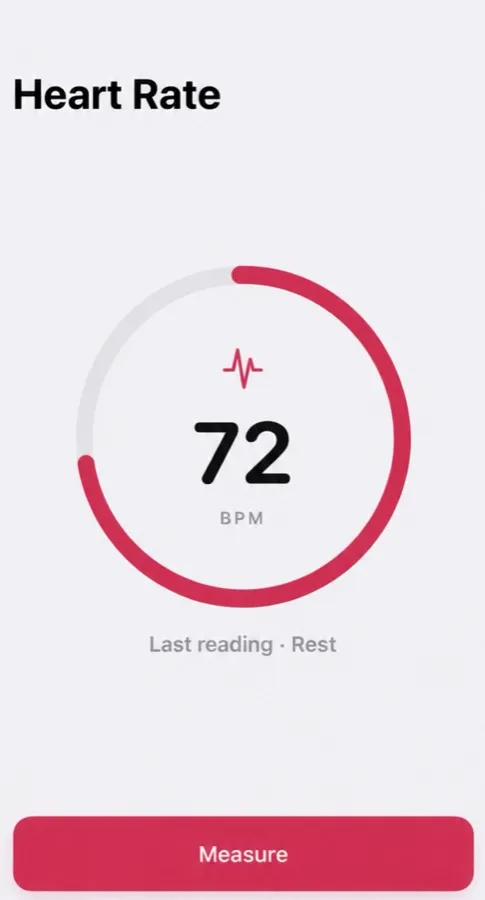
Want a real reading? Pulse reads it with your iPhone camera.
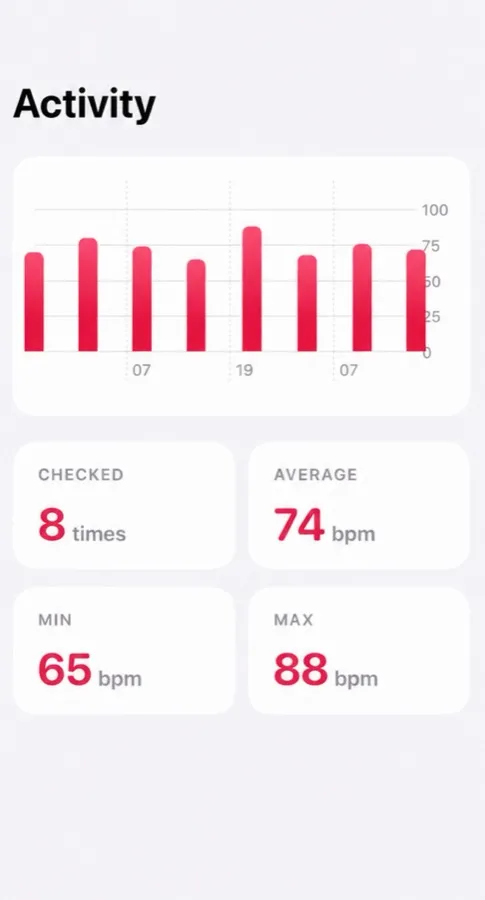
Cover the back camera with your fingertip — Pulse reads your heart rate from the light and keeps every reading, with your average, lowest and highest.
- Reads your pulse in about 15 seconds
- Tag each reading: morning, rest, workout, before bed
- History with average, min and max
Free to download, optional Pro. Not a medical device: Pulse reads and keeps your pulse, and it does not detect or predict disease. What the app does
Questions people ask
What is a normal resting heart rate for adults?
The American Heart Association uses 60 to 100 beats per minute for adults at rest. In CDC measurements of 14,200 U.S. adults, the middle value was about 70 in every adult age group, and 90 in 100 people sat between 54 and 91–93.
Does a normal heart rate change with age?
Yes, mostly in childhood. In the CDC data the middle resting pulse falls from 126 under age 1 to 85 at ages 6–8 and 73 at 16–19, then stays around 70 through adulthood. See every age group.
Why is my heart rate different every time I check?
Pulse responds to posture, breathing, coffee, stress and the time of day. Even trained examiners got only a moderate match between two visits on different days (a correlation of 0.69 in the CDC study). That is why one reading tells you little — seven mornings tell you a lot more.
Can this website measure my heart rate?
No. CheckMyBPM explains the number you already have. To get a number, count it by hand or use the Pulse app, which reads your pulse through the iPhone camera.
General information, not medical advice — medical disclaimer. Reviewed : sources and reference dates are listed below.
Sources · numbers checked · how we calculate · report an error
- American Heart Association. Target Heart Rates Chart.
- Ostchega Y, Porter KS, Hughes J, Dillon CF, Nwankwo T. Resting pulse rate reference data for children, adolescents, and adults: United States, 1999–2008. National Health Statistics Reports No. 41. NCHS, 2011.
- Mayo Clinic. Heart rate: What’s normal? (Expert answers).