Home › Heart rate zones
Heart rate zones calculator Zone 2 and target heart rate for your age.
Reviewed
Heart rate zone 2 is 60–70% of estimated maximum in this five-zone calculator: 108–126 BPM at age 40 using Tanaka. AHA moderate exercise uses a different range: 90–126 BPM at 40. Enter your age and optional resting pulse for your ranges below.
You
Zone 2: 108–126 BPM
Estimated maximum: 180 BPM
% of estimated maximum 180
Your 5 zones
| Zone | % of max | BPM |
|---|---|---|
| Zone 1 · Very light | 50–60% | 90–108 |
| Zone 2 · Light | 60–70% | 108–126 |
| Zone 3 · Moderate | 70–80% | 126–144 |
| Zone 4 · Hard | 80–90% | 144–162 |
| Zone 5 · Maximum | 90–100% | 162–180 |
AHA target heart rate: moderate 90–126 · vigorous 126–153 BPM (50–70% and 70–85% of 220 − age).
Target heart rate by age (AHA method).
Target heart rate = % of 220 − age · beats per minute
| Age | Max (220 − age) | Moderate 50–70% | Vigorous 70–85% | Zone 2 (Tanaka, 60–70%) |
|---|---|---|---|---|
| 20 | 200 | 100–140 | 140–170 | 116–136 |
| 25 | 195 | 98–137 | 137–166 | 115–134 |
| 30 | 190 | 95–133 | 133–162 | 112–131 |
| 35 | 185 | 93–130 | 130–157 | 110–129 |
| 40 | 180 | 90–126 | 126–153 | 108–126 |
| 45 | 175 | 88–122 | 122–149 | 106–124 |
| 50 | 170 | 85–119 | 119–145 | 104–121 |
| 55 | 165 | 83–115 | 115–140 | 102–119 |
| 60 | 160 | 80–112 | 112–136 | 100–116 |
| 65 | 155 | 78–109 | 109–132 | 98–114 |
| 70 | 150 | 75–105 | 105–128 | 95–111 |
| 75 | 145 | 73–102 | 102–123 | 94–109 |
| 80 | 140 | 70–98 | 98–119 | 91–106 |
The AHA’s percentages; the numbers are our arithmetic on 220 − age, rounded. The 5-zone split (50/60/70/80/90%) is a common fitness convention, not an AHA standard.
Zone 2, in plain words
Zone 2 is the easy end of steady exercise: 60–70% of your maximum. You can talk in full sentences, breathe through your nose, and keep going for a long time. Brisk walking, easy cycling and slow jogging often land here.
A watch or the Pulse app can tell you when you drift above it. Without one, the “talk test” works: if you can only say a few words at a time, you are past zone 2.
Which numbers to trust
Every maximum-heart-rate formula is an average across many people; your real maximum can be 10 or more beats away. Use zones as a starting point and adjust by feel.
If your resting pulse is known, the Karvonen method usually gives a narrower, more personal zone 2. Use your morning resting pulse — a reading after coffee will shift every zone.

Check your zone mid-workout. Pulse reads it in about 15 seconds.
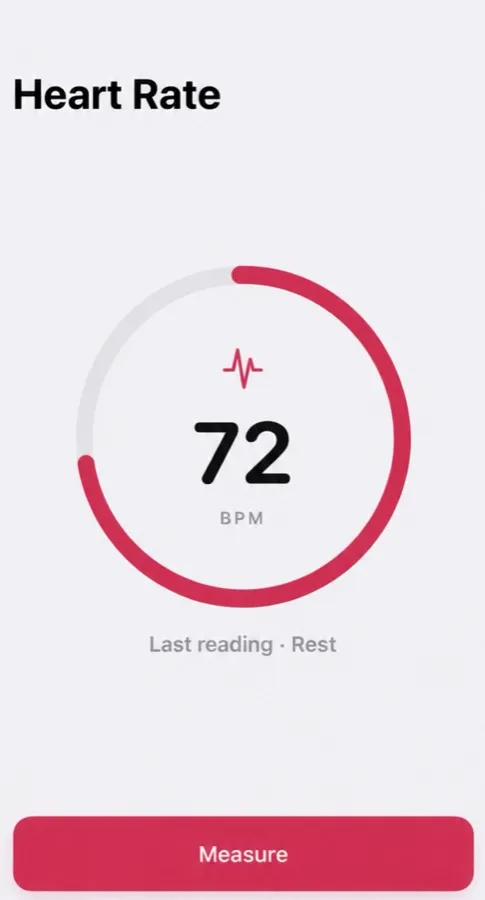
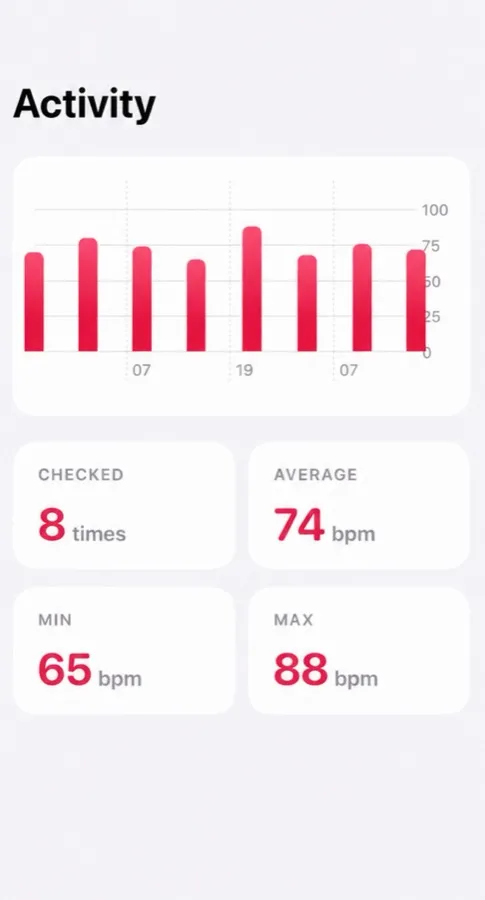
Cover the back camera with your fingertip — Pulse reads your heart rate from the light and keeps every reading, with your average, lowest and highest.
- Reads your pulse in about 15 seconds
- Tag each reading: morning, rest, workout, before bed
- History with average, min and max
Free to download, optional Pro. Not a medical device: Pulse reads and keeps your pulse, and it does not detect or predict disease. What the app does
Questions people ask
What is zone 2 heart rate?
Zone 2 is 60–70% of your maximum heart rate — easy, conversational effort. With the Tanaka estimate of maximum (208 − 0.7 × age), that is 112–131 BPM at 30, 108–126 at 40 and 104–121 at 50.
What is my target heart rate?
The American Heart Association’s target for moderate exercise is 50–70% of your maximum (220 − age), and 70–85% for vigorous exercise. At 40 that is 90–126 BPM moderate and 126–153 BPM vigorous.
Should I use 220 − age or 208 − 0.7 × age?
Both are averages. They agree at 40; 208 − 0.7 × age gives higher maximums for older adults and was fitted on far more data (Tanaka 2001). If you know your real maximum from a hard test, use that — see the formulas.
What is the Karvonen method?
Karvonen works from your heart rate reserve — maximum minus resting pulse — so two people of the same age with different resting pulses get different zones. Zone = resting + % × (maximum − resting). Type your resting pulse above to switch it on.
General information, not medical advice — medical disclaimer. Reviewed : sources and reference dates are listed below.
Sources · numbers checked · how we calculate · report an error
- American Heart Association. Target Heart Rates Chart.
- Tanaka H, Monahan KD, Seals DR. Age-predicted maximal heart rate revisited. J Am Coll Cardiol. 2001;37(1):153–156.
- Gellish RL, et al. Longitudinal modeling of the relationship between age and maximal heart rate. Med Sci Sports Exerc. 2007;39(5):822–829.
- Karvonen MJ, Kentala E, Mustala O. The effects of training on heart rate: a longitudinal study. Ann Med Exp Biol Fenn. 1957;35(3):307–315.