50 BPM is below the 60–100 range the American Heart Association uses for adults at rest. In CDC data, a resting 50 is lower than about 97–98 in 100 adults, depending on age. It is common during sleep and in people who do a lot of endurance exercise. Pick your situation for your own answer.
CDC data on resting pulse · AHA ranges · Numbers update for your age
50 BPM
ages 40–59
Below the usual resting range — lower than about 97 in 100 people aged 40–59
Middle value at rest for ages 40–59: 70 BPM. Feeling fine? Check again after 5 quiet minutes, and on a few mornings.
Resting pulse, your age: light band = middle 90 in 100 · dark = middle half · line = middle value · dot = 50
50 BPM at rest, by age and sex.
Where a resting 50 BPM sits — percentile (higher than X in 100 people of that age)
| Age | Everyone | Women | Men | Middle value | 90 in 100 between |
|---|---|---|---|---|---|
| 16–19 | 2 | 1 | 2 | 73 | 54–95 |
| 20–39 | 2 | <1 | 2 | 71 | 54–92 |
| 40–59 | 2 | <1 | 3 | 70 | 54–91 |
| 60–79 | 2 | <1 | 5 | 69 | 54–91 |
| 80+ | <2.5 | <2.5 | 4 | 70 | 54–93 |
CDC/NCHS NHANES 1999–2008: seated resting pulse counted by a trained examiner, people with no condition or medicine that changes pulse. “>99” = above the 99th percentile · “<1” = below the 1st. Full table for every age.
When 50 BPM is common
- Asleep, or in the first minutes after waking — your heart rate is usually at its lowest of the day.
- Regular endurance training — running, cycling, rowing and swimming lower the resting pulse over months.
- Lying down and relaxed — pulse drops a few beats compared with sitting.
- Some prescription medicines, such as beta-blockers — slow the pulse — your prescriber will know if yours does.
One reading moves around. Your number on 7 mornings, before you get up, is the one to compare.
When to talk to a clinician
A single reading moves around a lot. If your resting pulse is above 100 on most mornings, or below 50 and you are not a trained endurance athlete, mention it at your next checkup — bring your readings.
If a fast or slow pulse comes with chest pain, fainting, feeling about to faint, or trouble breathing, call 911 or your local emergency number now.
Nearby numbers

Not sure your number is right? Pulse reads it with your iPhone camera.
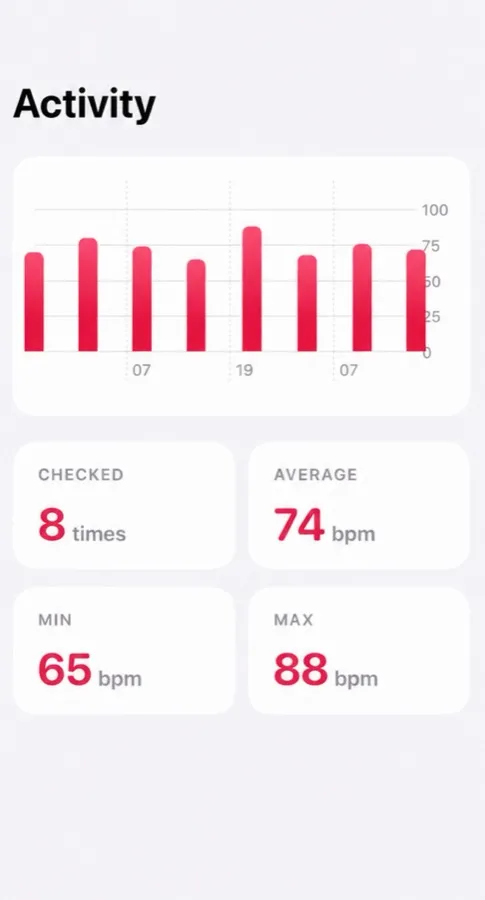
Cover the back camera with your fingertip — Pulse reads your heart rate from the light and keeps every reading, with your average, lowest and highest.
- Reads your pulse in about 15 seconds
- Tag each reading: morning, rest, workout, before bed
- History with average, min and max
Free to download, optional Pro. Not a medical device: Pulse reads and keeps your pulse, and it does not detect or predict disease. What the app does
Questions people ask
Is 50 BPM too low when sleeping?
Not by itself. Pulse normally drops during sleep, so a sleeping number below your daytime resting pulse is expected. What matters is how you feel when awake and your resting number on several mornings.
Is a resting heart rate of 50 good?
For a trained endurance athlete it is common. For someone who isn’t, it sits below the 60–100 range and below about 97 in 100 adults — worth a mention at your next checkup if it is your usual awake number, especially with dizziness or tiredness.
What heart rate is too low?
There is no single cut-off that fits everyone. Talk to a clinician if your awake resting pulse is usually below 50 and you are not an athlete, and get help right away if a slow pulse comes with fainting, chest pain or trouble breathing.
General information, not medical advice — medical disclaimer. Reviewed : sources and reference dates are listed below.
Sources · numbers checked · how we calculate · report an error
- American Heart Association. Target Heart Rates Chart.
- Ostchega Y, Porter KS, Hughes J, Dillon CF, Nwankwo T. Resting pulse rate reference data for children, adolescents, and adults: United States, 1999–2008. National Health Statistics Reports No. 41. NCHS, 2011.
- Tanaka H, Monahan KD, Seals DR. Age-predicted maximal heart rate revisited. J Am Coll Cardiol. 2001;37(1):153–156.
- Mayo Clinic. Heart rate: What’s normal? (Expert answers).