A heart rate log needs four columns: date, time, BPM and what you were doing. Check in the morning before you get up, or after sitting for 5 minutes, at the same time each day, for 7 days unless your doctor asks for longer. Download a blank sheet below, or type your readings to get a PDF to bring along.
1 · Blank sheet
7 days: one row a day, with room for notes.
Your name prints on the sheet only. It’s never saved or sent.
2 · Or type your readings
No readings yet.
Stays in this browser. Nothing is sent to us.
Before a doctor’s visit
Bring these, and ask the office if they want anything else:
- This log, or your record from an app or watch.
- Every medicine and supplement you take, with doses. Some change your pulse.
- Your symptoms and when they happened, in your own words.
- Your questions, written down.
If your doctor asks you to keep a diary
A diary is for moments, not a daily routine. When something happens, note the date and time, what you were doing, how long it lasted, your pulse if you could count it, and how you felt.
A diary sheet is for your records. This page doesn’t read or sum up what you write.
How to get numbers worth writing down
- Check in the morning before you get up, or after sitting for 5 minutes. No coffee or exercise just before.
- Use the same position and time each day.
- Count for 30 seconds and double it, or use the same device each time.
- Write it down straight away, with a short note.
How to read your own sheet
The middle value ignores one odd day. In a study of 92,457 people, the average person moved about 3 BPM from day to day, so small changes are ordinary. Want the number in context? Take the 7-morning check or compare two weeks.

Tired of writing it down? Pulse keeps the record.
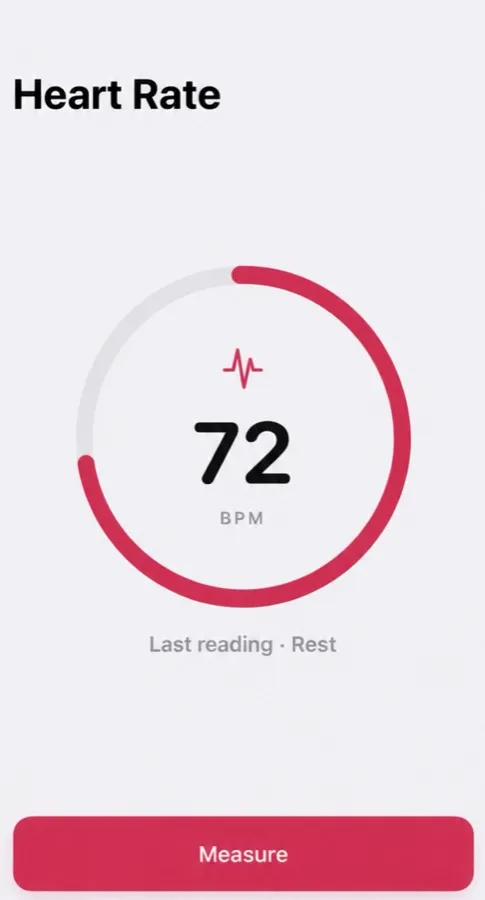
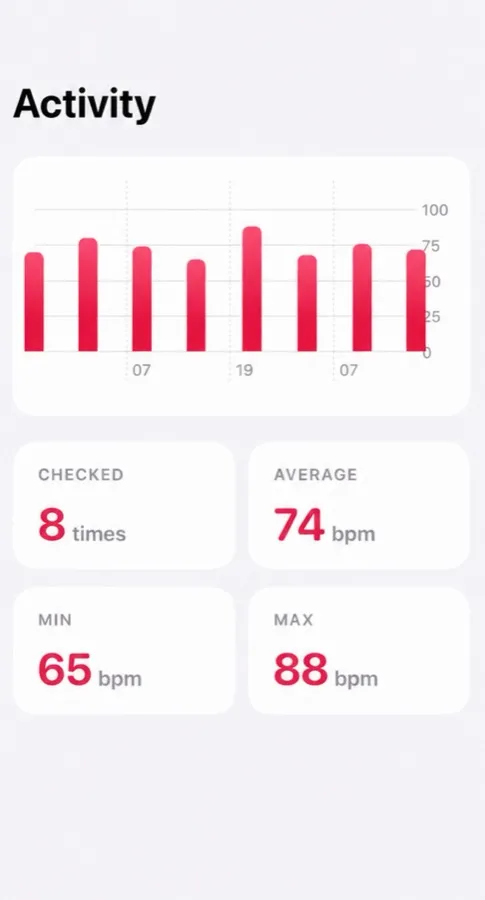
Pulse reads your fingertip with the iPhone camera, keeps your notes and makes the PDF for you, for the last 7, 30 or 90 days. The PDF is a Pro feature.
- Reads your pulse in about 15 seconds
- Tag each reading: morning, rest, workout, before bed
- History with average, min and max
Free to download, optional Pro. Not a medical device: Pulse reads and keeps your pulse, and it does not detect or predict disease. What the app does
When to talk to a clinician
A single reading moves around a lot. If your resting pulse is above 100 on most mornings, or below 50 and you are not a trained endurance athlete, mention it at your next checkup — bring your readings.
If a fast or slow pulse comes with chest pain, fainting, feeling about to faint, or trouble breathing, call 911 or your local emergency number now.
Questions people ask
How do I record my heart rate for a doctor?
Check at the same time and in the same position each day, in the morning before you get up, or after sitting for 5 minutes. Write the date, time, BPM and what you were doing. Ask your doctor how many days they want to see, then bring the sheet.
What should a heart rate log include?
Date, time, your pulse in BPM, and a short note on what you were doing or how you felt. Those four columns let someone else read the numbers in context.
How many days should I log?
Use what your doctor asks for. If nobody has said, 7 days of morning readings give a fair picture, and 14 or 30 days show more of how your number moves.
Does this page save my readings?
They stay in this browser on this device, and nothing is sent to us. Your name is never saved or put in a link. Clear the list whenever you like.
Can this log tell me if something is wrong?
No. It adds up your numbers and shows the middle, lowest and highest. Only a clinician can say what they mean for you.
General information, not medical advice — medical disclaimer. Reviewed : sources and reference dates are listed below.
Sources · numbers checked · how we calculate · report an error
- American Heart Association. Target Heart Rates Chart.
- Quer G, Gouda P, Galarnyk M, Topol EJ, Steinhubl SR. Inter- and intraindividual variability in daily resting heart rate and its associations with age, sex, sleep, BMI, and time of year. PLoS One. 2020;15(2):e0227709.
- NHS. Heart palpitations (reviewed March 2026).