Most rises in resting heart rate come from everyday things: fever, alcohol, stress, poor sleep, heat or dehydration. A fever alone adds about 7 BPM per 1 °C in adults. If your number looks high, look for your cause below, then compare it with your own usual number.
What moves a resting pulse
Effect sizes come from the sources below. They are averages from specific groups of people, not predictions for you.
| Cause | What is known | Read more |
|---|---|---|
| Fever | About 7 BPM per 1 °C in adults, 10 in children (emergency visits). | Heart rate with a fever |
| Alcohol | Linked to fast rhythms that evening and poorer recovery overnight. | Alcohol and heart rate |
| Stress and anxiety | Stress hormones increase your pulse. | Anxiety and heart rate |
| Caffeine | May raise it, but small studies disagree. | Heart rate after coffee |
| Short sleep | 5.5 BPM higher by day during recovery in a small trial. | Sleep and heart rate |
| Heat and dehydration | About 6 BPM per 1% of body mass lost, in runners in the heat. | Heat and dehydration |
| Pregnancy | Median rose about 9 BPM from 12 to 34 weeks. | Heart rate during pregnancy |
| Moving and standing | Your pulse rises within seconds of getting up. | Heart rate in the morning |
| Time of year | About 2 BPM across the year, highest in January, lowest in July. | Why track your resting pulse |
| Medicines | Some raise it, such as pseudoephedrine in cold remedies. Beta blockers slow it. Ask a pharmacist about yours. | MedlinePlus on stimulants |
| Medical causes | Less often an overactive thyroid, iron deficiency anaemia, an arrhythmia or a heart valve problem. Only a clinician can sort these out. | What heart rate is dangerous |
Your usual vs. today, or week vs. week
Your usual vs. today
+8 BPM against your usual 62.
Compare two weeks
Type up to 7 mornings, with a space or comma between numbers. We use the middle value of each week.
The difference
+8 BPM against your usual 62.
That is more than an average day-to-day change. Note what is different today and count again tomorrow morning before reading much into it.
If your resting heart rate went up
Compare weeks, not days. Open “Compare two weeks” above, type last week’s and this week’s mornings, and the tool uses the middle value of each. One odd morning won’t move it.
How much is ordinary?
The average person in a study of 92,457 wearers moved about 3 BPM from day to day, and about 1 in 5 had at least one week swinging 10 BPM or more. If a rise stays over several mornings, or you feel unwell, bring your log to a clinician.
Sleep and heart rate
In a lab trial, 15 healthy young men slept 5 hours a night for five nights, then had two long recovery nights. Daytime heart rate was slightly lower during the short nights (by 1.2 BPM) but 5.5 BPM higher during recovery than at the start. Across the whole study it rose by 7.6 BPM after accounting for days and time of measurement. Two nights of catch-up sleep did not bring it back.
It is a small study of one group. In 92,457 wearers, the lowest resting numbers belonged to people averaging 7 to 7.5 hours of sleep.
Heat and dehydration
In a trail-running study in the heat, heart rate rose about 6 BPM for every extra 1% of body mass lost to dehydration. That was measured right after running, so a resting number will not move as much.
Hot weather also raises your pulse because your body sends more blood to the skin to cool down. If you have a fast heartbeat with confusion, hot skin that isn’t sweating or fast breathing, or you still feel unwell after 30 minutes in a cool place, the NHS treats that as possible heatstroke: call 911.
When to talk to a clinician
A single reading moves around a lot. If your resting pulse is above 100 on most mornings, or below 50 and you are not a trained endurance athlete, mention it at your next checkup — bring your readings.
If a fast or slow pulse comes with chest pain, fainting, feeling about to faint, or trouble breathing, call 911 or your local emergency number now.
Find your usual number first
“High” only means something against your own normal. In a study of 92,457 people, the average person moved about 3 BPM from day to day, while one person’s normal could differ from another’s by nearly 70 BPM. The 7-morning heart rate check gives you that usual number, and a link back here with it filled in.

Note what changed. Pulse keeps your mornings.
Read your pulse each morning and tag it. Over a few weeks you see your own trend, and you can show it to your doctor.
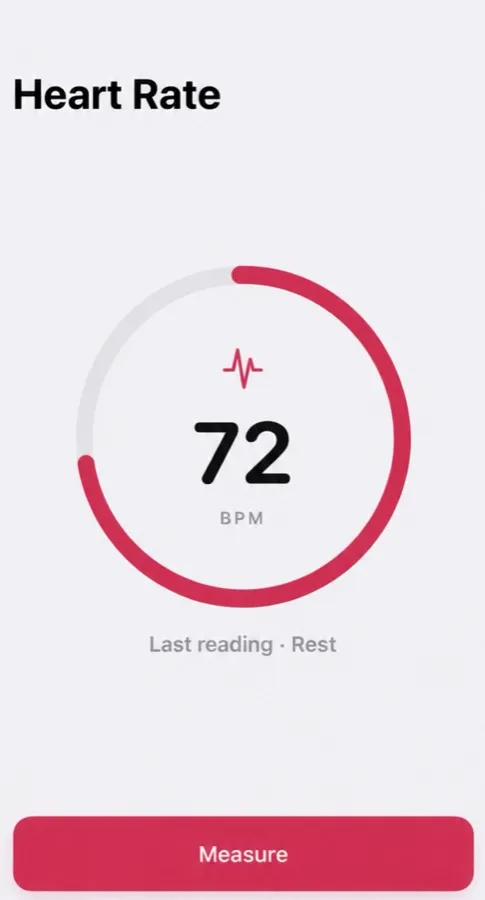
- Reads your pulse in about 15 seconds
- Tag each reading: morning, rest, workout, before bed
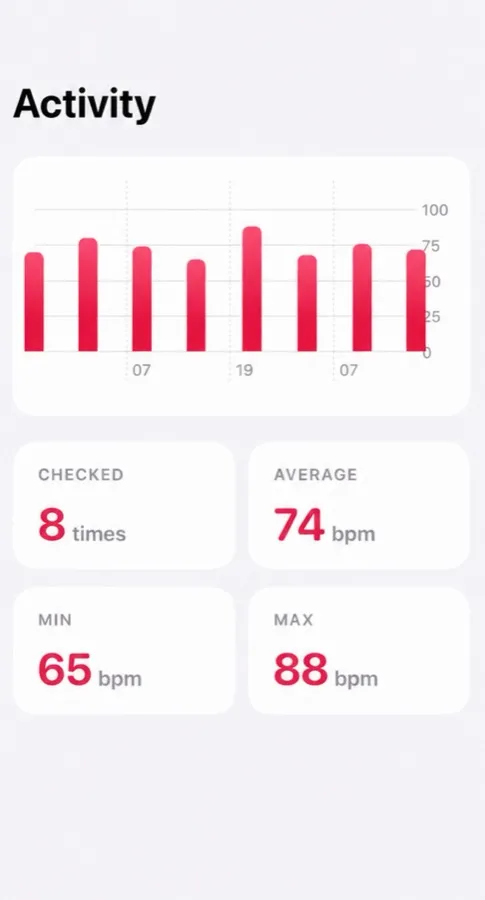
- History with average, min and max
Free to download, optional Pro. Not a medical device: Pulse reads and keeps your pulse, and it does not detect or predict disease. What the app does
Questions people ask
Why is my resting heart rate so high all of a sudden?
Common reasons are poor sleep, alcohol, stress, dehydration, heat or an illness starting. Count again after sitting quietly for 5 minutes, then over the next few mornings. If it stays high, or you feel unwell, get checked.
My resting heart rate went up 10 BPM in a week. Is that normal?
It happens. In a study of 92,457 wearers, about 1 in 5 people had at least one week with a swing of 10 BPM or more. Look for what changed, such as sleep, alcohol, stress, heat or a cold, and keep counting for a few mornings. If you also feel unwell, talk to a clinician.
Why did my resting heart rate go from 60 to 80?
Check it first: sit for 5 minutes and count by hand for 30 seconds. If it stays high over several mornings, or you feel unwell, bring your readings to a clinician.
What causes a high resting heart rate?
Usually something temporary from the list above. If it stays above 100 on most mornings, a clinician should look for a cause.
Is a high resting heart rate bad?
One high reading says little. Over the long term, higher resting rates are linked with worse health in population studies, though that doesn’t show cause. Resting heart rate and longevity.
General information, not medical advice — medical disclaimer. Reviewed : sources and reference dates are listed below.
Sources · numbers checked · how we calculate · report an error
- Quer G, Gouda P, Galarnyk M, Topol EJ, Steinhubl SR. Inter- and intraindividual variability in daily resting heart rate and its associations with age, sex, sleep, BMI, and time of year. PLoS One. 2020;15(2):e0227709.
- Kirschen GW, Singer DD, Thode HC Jr, Singer AJ. Relationship between body temperature and heart rate in adults and children: a local and national study. Am J Emerg Med. 2020;38(5):929–933.
- Davies P, Maconochie I. The relationship between body temperature, heart rate and respiratory rate in children. Emerg Med J. 2009;26(9):641–643.
- Reichenberger DA, Ness KM, Strayer SM, et al. Recovery sleep after sleep restriction is insufficient to return elevated daytime heart rate and systolic blood pressure to baseline levels. Psychosom Med. 2023;85(8):744–751.
- Casa DJ, Stearns RL, Lopez RM, et al. Influence of hydration on physiological function and performance during trail running in the heat. J Athl Train. 2010;45(2):147–156.
- Green L, et al. Gestation-specific vital sign reference ranges in pregnancy. Obstet Gynecol. 2020;135(3):653–664.
- MedlinePlus. Stimulants (pseudoephedrine, caffeine; reviewed January 2025).
- MedlinePlus. Stress and your health (reviewed May 2026).
- NHS. Beta blockers (reviewed September 2026).
- NHS. Heart palpitations (reviewed March 2026).
- NHS. Heat exhaustion and heatstroke (reviewed May 2026).