Home › Guide
How to lower your resting heart rate What the trials found, and how long it takes.
Reviewed
Regular exercise can lower your everyday resting heart rate over weeks. For the next few minutes instead, see breathing to lower your heart rate. A review of 191 exercise studies found an average drop of about 3 BPM compared with people who did not exercise, with endurance training and yoga showing the clearest effect, typically over about three months. Set your re-check reminders below.
Re-check reminders
Count on day one, then every 4 weeks
4 calendar reminders across 12 weeks, so you compare the same kind of reading each time.
Add 4 re-checks to my calendarWhat the trials found
- All exercise types together: about 3.3 BPM lower than non-exercising groups.
- Endurance training: 2.7–5.8 BPM lower, depending on the group.
- Yoga: about 5 BPM lower.
- Strength training: a significant drop in women only, about 2 BPM.
The higher your starting number, the more it tended to fall. Older participants dropped less than younger ones. On average, the effect showed up after about three months at three sessions a week.
A realistic plan
- Find your starting number with the 7-morning check.
- Pick something you can repeat three times a week: brisk walking, cycling, swimming or yoga. See your heart rate zones for pace.
- Count again every four weeks, the same way, in the same place.
Things that raise it, which you can take away
Before you read a change as fitness, look at what else moved. Alcohol, short sleep, heat and illness all push the morning number up. See what raises your heart rate. In one study of 92,457 wearers, the lowest resting numbers belonged to people sleeping 7 to 7.5 hours a night.
What we can’t promise
A lower number does not prove you are healthier, and no trial has shown that lowering your pulse on its own adds years of life. Studies only link resting pulse with long-term health, as explained in resting heart rate and longevity. Exercise has other reasons to recommend it. If you have a heart condition or take heart medicine, ask your clinician before you start.
When to talk to a clinician
A single reading moves around a lot. If your resting pulse is above 100 on most mornings, or below 50 and you are not a trained endurance athlete, mention it at your next checkup — bring your readings.
If a fast or slow pulse comes with chest pain, fainting, feeling about to faint, or trouble breathing, call 911 or your local emergency number now.
More questions

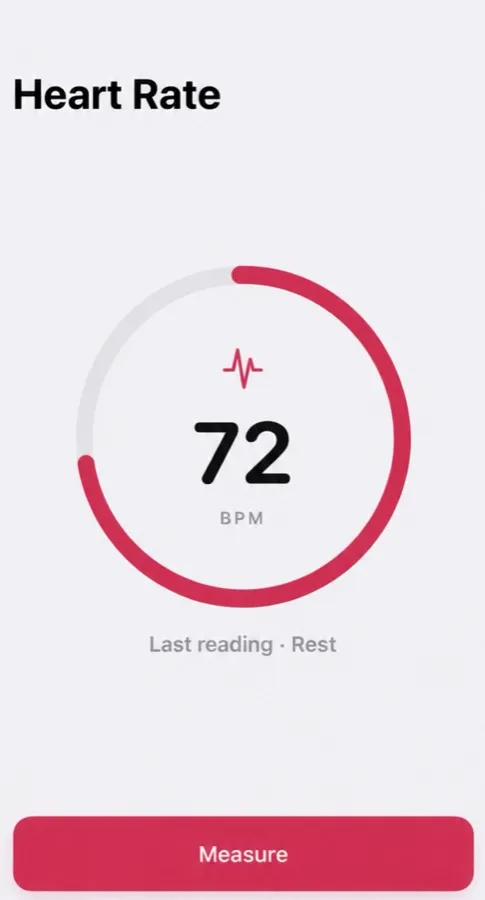
Want a real reading? Pulse reads it with your iPhone camera.
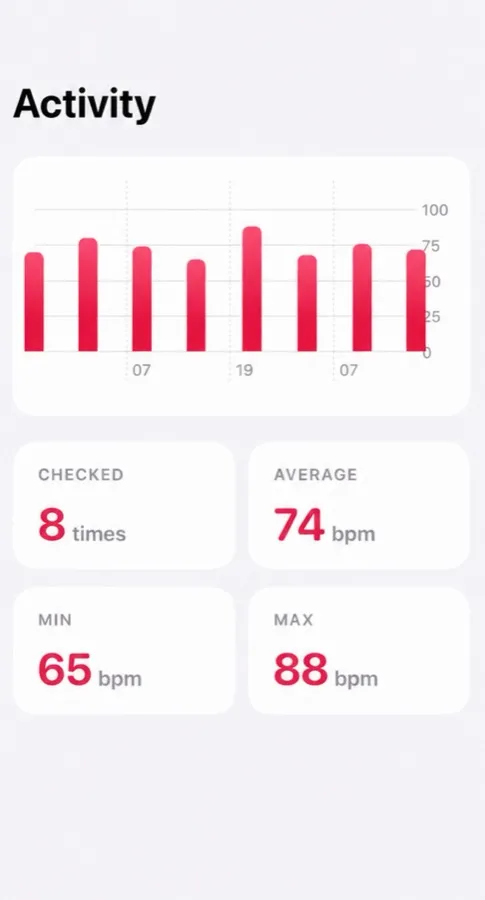
Cover the back camera with your fingertip — Pulse reads your heart rate from the light and keeps every reading, with your average, lowest and highest.
- Reads your pulse in about 15 seconds
- Tag each reading: morning, rest, workout, before bed
- History with average, min and max
Free to download, optional Pro. Not a medical device: Pulse reads and keeps your pulse, and it does not detect or predict disease. What the app does
Questions people ask
How long does it take to lower resting heart rate?
In the exercise trials, the effect appeared after about three months of three sessions a week on average.
How much can you lower your resting heart rate?
The average across trials was about 3 BPM, and 2.7–5.8 BPM for endurance training. People who start higher tend to drop more.
What lowers heart rate immediately?
Sitting quietly for a few minutes brings a raised number down. That is settling, not a lasting change in your resting pulse. If a fast heartbeat does not settle or you feel unwell, see what heart rate is dangerous.
General information, not medical advice — medical disclaimer. Reviewed : sources and reference dates are listed below.
Sources · numbers checked · how we calculate · report an error
- Reimers AK, Knapp G, Reimers CD. Effects of exercise on the resting heart rate: a systematic review and meta-analysis of interventional studies. J Clin Med. 2018;7(12):503.
- Quer G, Gouda P, Galarnyk M, Topol EJ, Steinhubl SR. Inter- and intraindividual variability in daily resting heart rate and its associations with age, sex, sleep, BMI, and time of year. PLoS One. 2020;15(2):e0227709.
- American Heart Association. Target Heart Rates Chart.